
Part 10: Different Types of Deep Learning: A Complete Overview
Introduction
Namaste, and welcome! Over the past nine blogs, we have journeyed through the fascinating world of neural networks. From the birth of the perceptron to understanding how backpropagation works, we've covered it all.
"Humne ANN ka safar poora kiya hai."
We started with the basics: what is a neuron, how does a perceptron work, and why one neuron is never enough. We then explored multi-layer perceptrons, understood forward propagation, and mastered backpropagation. We even implemented everything from scratch using NumPy and saw how it works in practice with TensorFlow/Keras.
But here's the thing: Artificial Neural Networks (ANNs) are just the beginning. The deep learning universe is vast and exciting. There are many other architectures designed for specific tasks, and today we're going to explore them all.
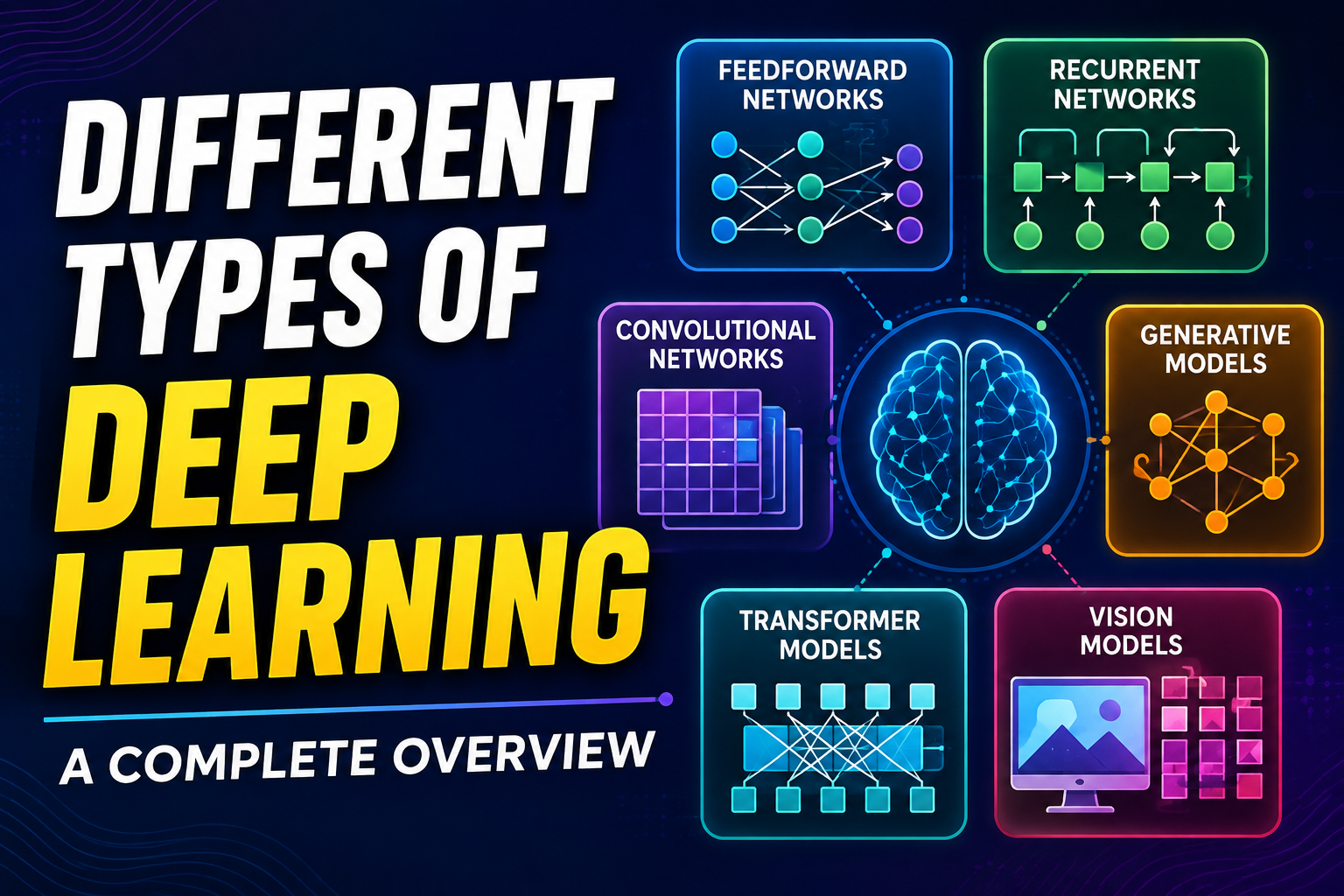
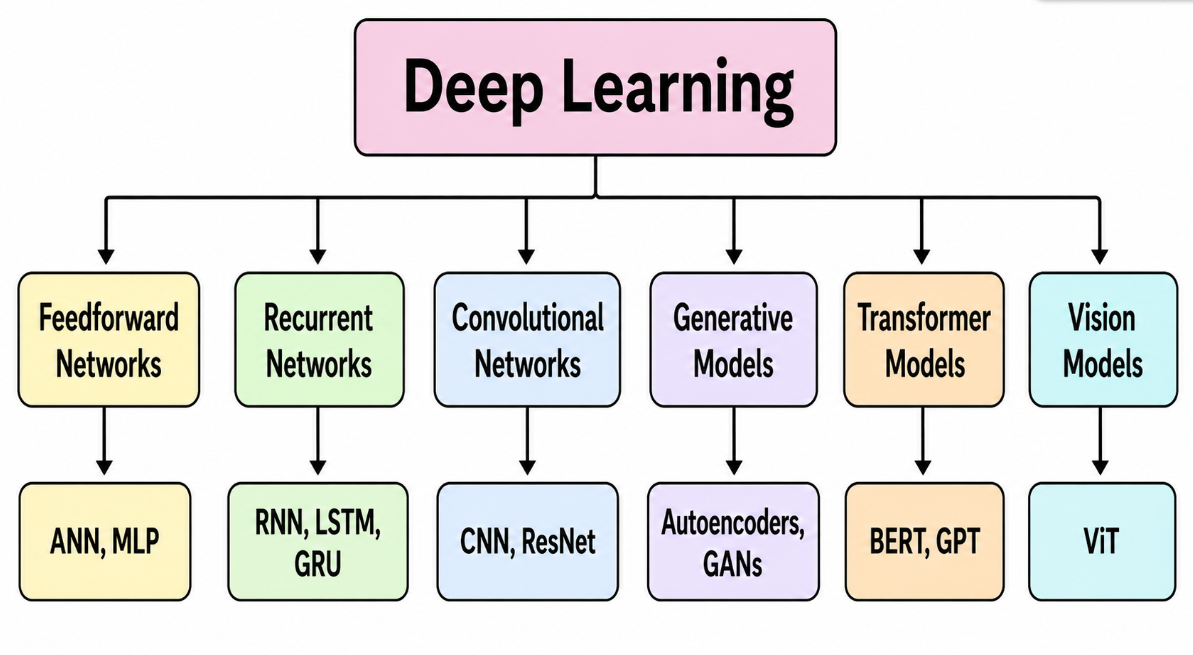
Now, let's explore what comes next. The deep learning ecosystem can be broadly categorized into several types based on architecture and application. Here's a quick preview:
Why Different Types of Deep Learning?
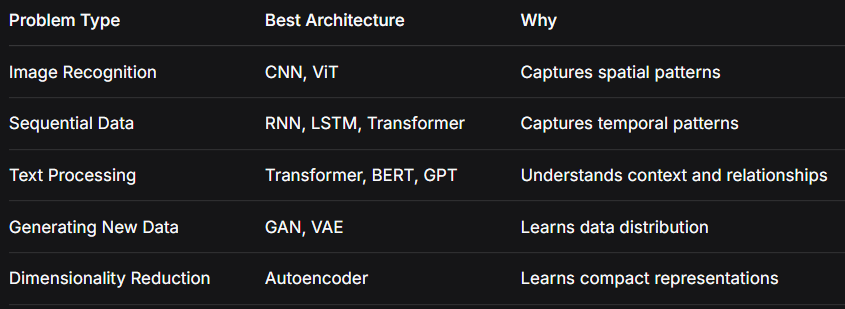
You might be wondering: why do we need so many different architectures? Can't we just use ANNs for everything?
The answer is simple: different problems require different solutions.
"Har problem ke liye ek specific architecture hota hai."
Let's explore each major type in detail.
1. Convolutional Neural Networks (CNNs)
What Are CNNs?
Convolutional Neural Networks are specialized for processing grid-like data, such as images. They were inspired by the visual cortex of animals and are designed to automatically and adaptively learn spatial hierarchies of features .
How Do They Work?
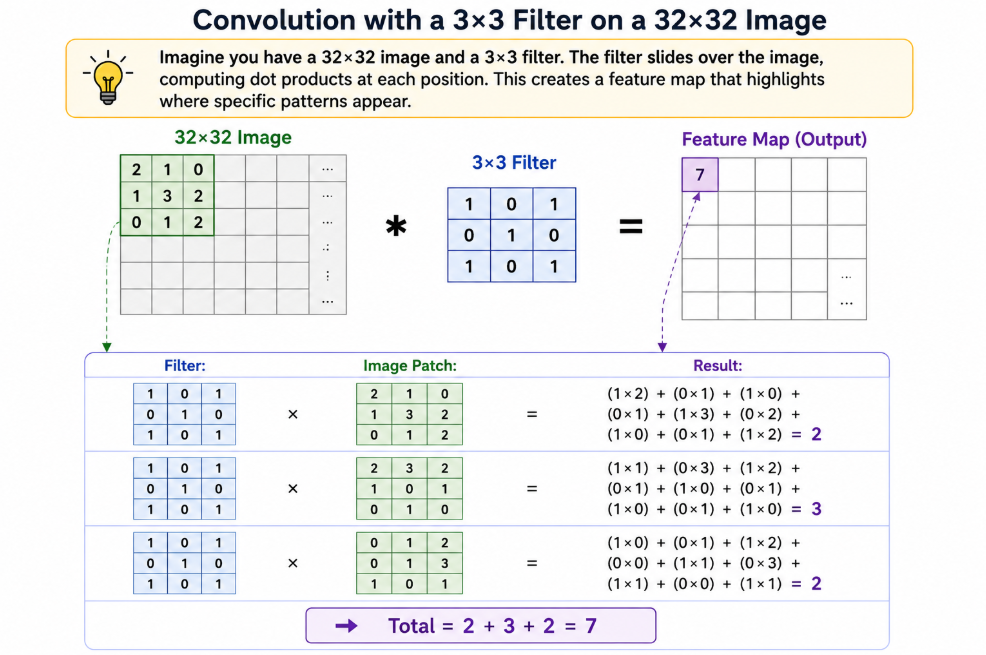
CNNs use a mathematical operation called convolution to process data. Instead of connecting every neuron to every other neuron (like in ANNs), CNNs use filters that slide over the input data.
Think of it like scanning a document with a magnifying glass. You don't look at the entire document at once. You look at small patches, one after another, and these patches capture local patterns like edges, textures, and shapes.
Key Components
-
Convolutional Layer: Applies filters to extract features
-
Pooling Layer: Reduces spatial dimensions
-
Fully Connected Layer: Makes the final prediction
The Filter Process
Why CNNs Are Powerful
CNNs have several advantages over traditional ANNs:
-
Parameter Sharing: The same filter is used across the entire image
-
Spatial Hierarchy: They learn simple features first, then complex ones
-
Translation Invariance: They can recognize patterns regardless of position
This makes CNNs incredibly efficient for image tasks. They can achieve high accuracy with far fewer parameters than a fully connected network.
Applications of CNNs
CNNs power almost everything related to images:
-
Image Classification: Identifying objects in photos
-
Object Detection: Finding and locating objects
-
Semantic Segmentation: Pixel-level classification
-
Medical Imaging: Detecting diseases from X-rays, MRIs
-
Self-Driving Cars: Recognizing traffic signs, pedestrians
-
Facial Recognition: Identifying people
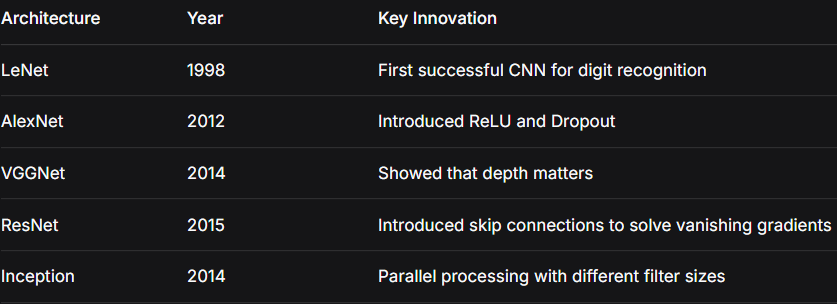
CNN Architectures
2. Recurrent Neural Networks (RNNs)
What Are RNNs?
Recurrent Neural Networks are designed for sequential data. While feedforward networks assume inputs are independent, RNNs have internal memory that captures information from previous time steps .
"RNN mein network ko memory hoti hai. Woh past inputs ko yaad rakhta hai."
How Do They Work?
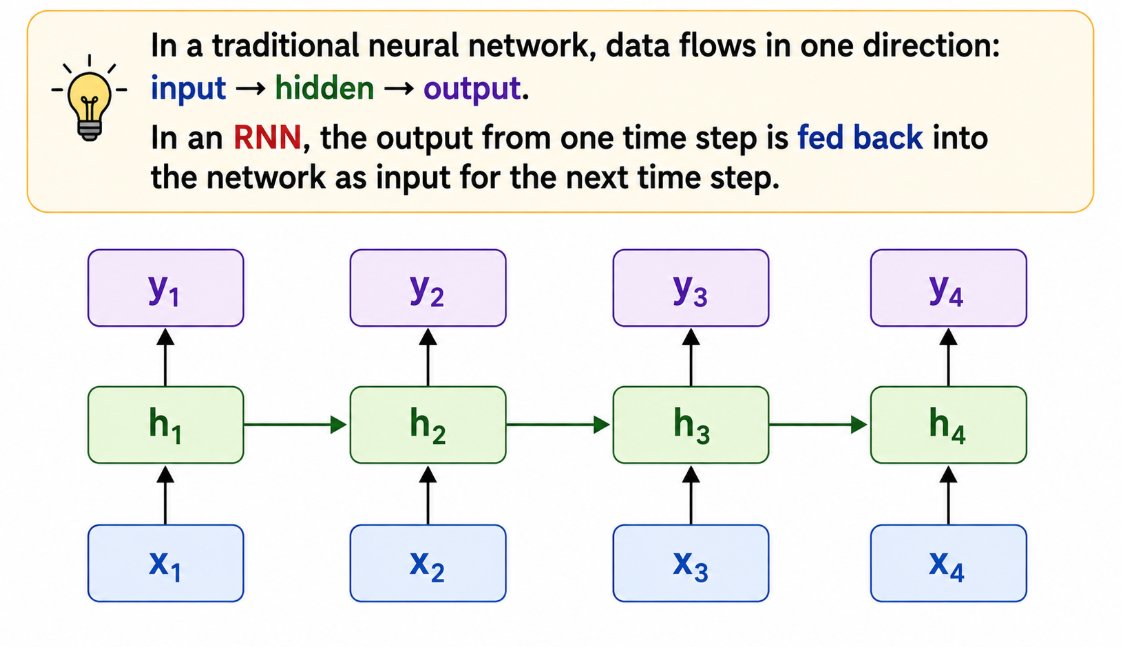
The hidden state hₜ depends on both the current input xₜ and the previous hidden state hₜ₋₁:
hₜ = f(Wₕₕ × hₜ₋₁ + Wₓₕ × xₜ + b)
Types of RNNs
-
Simple RNN: Basic recurrent connections
-
LSTM (Long Short-Term Memory): Can remember information for long periods
-
GRU (Gated Recurrent Unit): Simplified version of LSTM
The Vanishing Gradient Problem in RNNs
RNNs suffer from a serious problem: as sequences get longer, the gradient vanishes. This is why training RNNs on long sequences is difficult.
LSTMs were designed to solve this problem. They use gates to control what information is remembered and what is forgotten.
"LSTM mein gates hain jo information ko selectively remember karte hain."
Applications of RNNs
RNNs are used for any task involving sequences:
-
Natural Language Processing: Text generation, translation
-
Time Series Prediction: Stock prices, weather forecasting
-
Speech Recognition: Converting speech to text
-
Music Generation: Composing music
-
Video Analysis: Understanding motion patterns
3. Transformers and BERT
What Are Transformers?
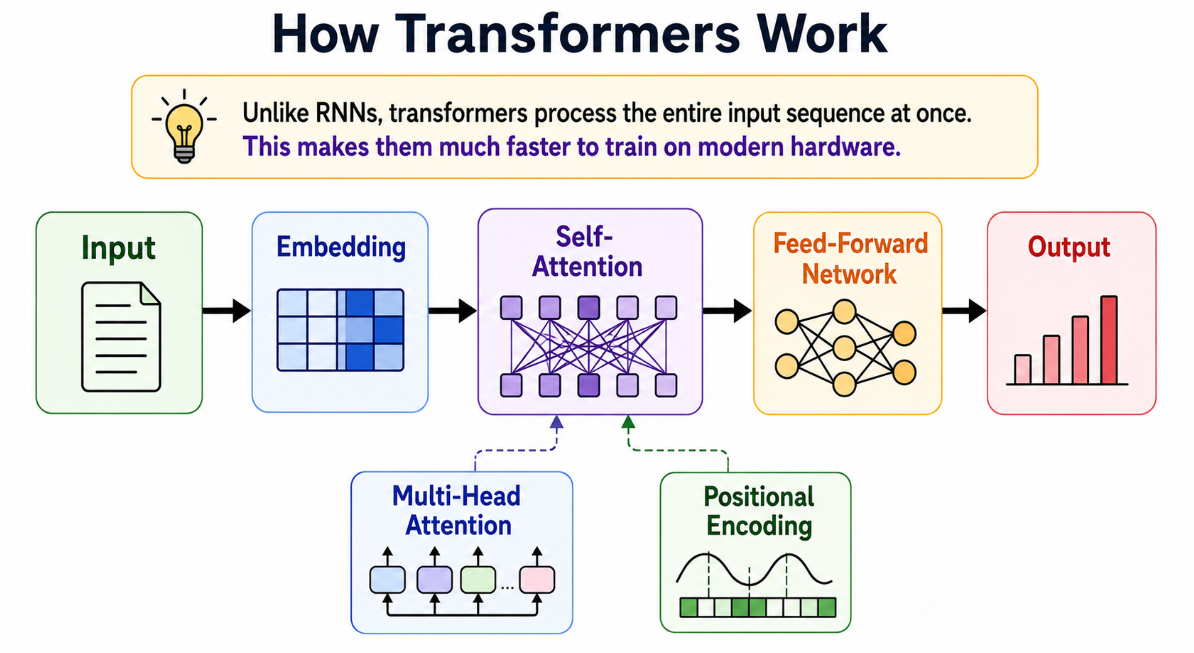
Transformers represent a paradigm shift in deep learning. Instead of processing data sequentially (like RNNs), transformers process data in parallel using a mechanism called self-attention.
Introduced in 2017, transformers have become the dominant architecture for natural language processing and are now being used in computer vision and other domains .
"Transformers ne RNN ko replace kiya hai. Yeh parallel mein data process karte hain."
The Attention Mechanism
The key innovation of transformers is attention. It allows the model to focus on the most relevant parts of the input when making predictions.
For example, when translating a sentence, the model can pay attention to specific words that are most relevant for the current translation.
The self-attention mechanism computes:
Attention(Q, K, V) = softmax(Q × Kᵀ / √d) × V
Where Q, K, and V are Query, Key, and Value vectors.
How Transformers Work
Unlike RNNs, transformers process the entire input sequence at once. This makes them much faster to train on modern hardware.
BERT: Bidirectional Encoder Representations from Transformers
BERT was introduced by Google in 2018. It's a transformer-based model that learns bidirectional representations of text .
This means BERT understands words in the context of the entire sentence (both left and right), rather than just left-to-right like traditional language models.
"BERT ne NLP mein revolutionary change laaya."
BERT's Training Approach
BERT uses two novel pre-training tasks:
-
Masked Language Model: Randomly mask words and predict them from context
-
Next Sentence Prediction: Predict if two sentences are consecutive
This approach has been extremely successful, and BERT has become a standard in NLP.
Applications of Transformers and BERT
-
Machine Translation: Google Translate
-
Text Classification: Sentiment analysis, spam detection
-
Question Answering: Search engines, chatbots
-
Text Summarization: Automatic summarization
-
Language Generation: ChatGPT, GPT-3/4
-
Code Generation: GitHub Copilot
4. Generative Adversarial Networks (GANs)
What Are GANs?
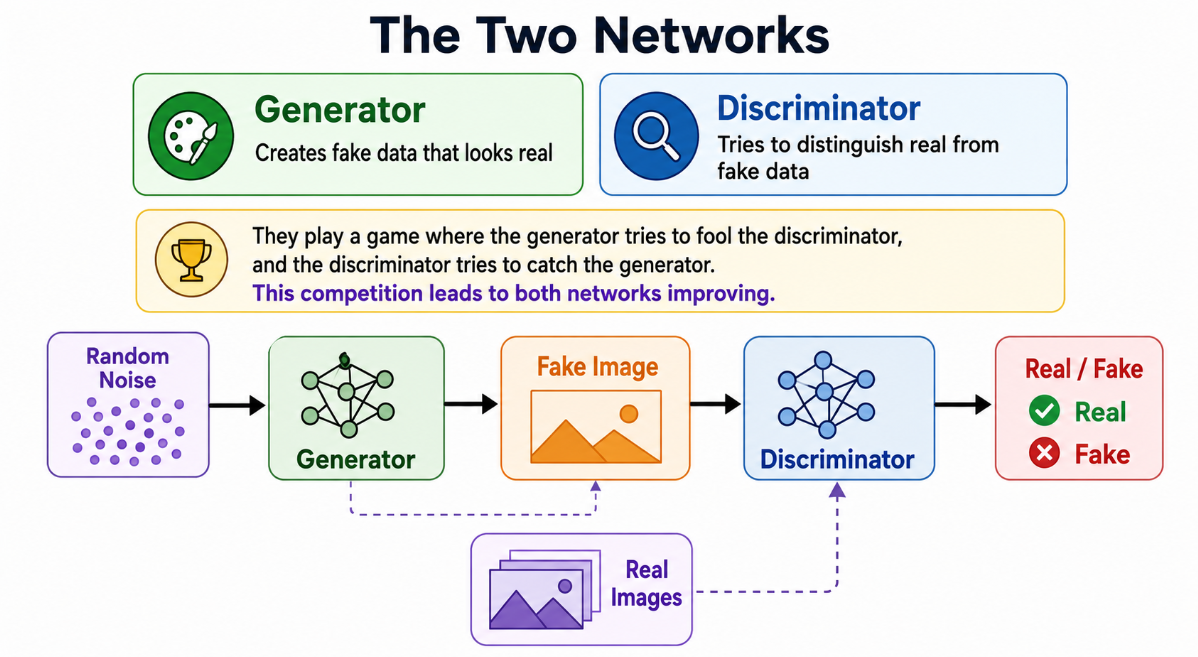
GANs are a fascinating class of deep learning models that consist of two networks competing against each other .
"GAN mein do networks aapas mein compete karte hain."
The Two Networks
Generator: Creates fake data that looks real
Discriminator: Tries to distinguish real from fake data
They play a game where the generator tries to fool the discriminator, and the discriminator tries to catch the generator. This competition leads to both networks improving.
How GANs Learn
The training process of GANs is a minimax game:
Loss = min_G max_D [log(D(x)) + log(1 - D(G(z)))]
-
Generator tries to minimize the loss
-
Discriminator tries to maximize it
This game eventually reaches an equilibrium where the generator produces highly realistic data .
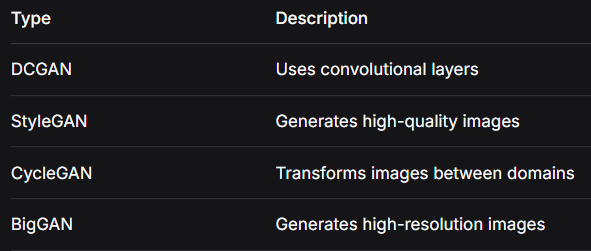
Types of GANs
Applications of GANs
-
Image Generation: Creating realistic faces, landscapes
-
Image Enhancement: Super-resolution, colorization
-
Data Augmentation: Creating synthetic training data
-
Style Transfer: Converting photos to artwork
-
Medical Imaging: Creating synthetic medical images
-
Video Generation: Creating realistic videos
"GANs ka use imagination create karne mein hota hai."
5. Autoencoders
What Are Autoencoders?
Autoencoders are unsupervised learning models that learn to compress and reconstruct data .
Architecture
Input → Encoder → Bottleneck (Latent Space) → Decoder → Reconstruction
-
Encoder: Compresses the input into a lower-dimensional representation
-
Bottleneck: The compressed representation (latent space)
-
Decoder: Reconstructs the original input from the compressed representation
Types of Autoencoders
-
Standard Autoencoder: Basic compression and reconstruction
-
Variational Autoencoder (VAE): Learns a probability distribution
-
Denoising Autoencoder: Learns to remove noise
-
Sparse Autoencoder: Enforces sparsity in the hidden layer
Applications of Autoencoders
-
Dimensionality Reduction: Compressing data
-
Denoising: Removing noise from images
-
Anomaly Detection: Detecting unusual patterns
-
Image Reconstruction: Filling missing parts
-
Feature Extraction: Learning useful representations
-
Generative Modeling: Creating new data (VAEs)
6. Transfer Learning
What Is Transfer Learning?
Transfer learning is a technique where knowledge gained from one task is applied to a different but related task .
Instead of training a model from scratch, you start with a pre-trained model and fine-tune it on your specific task.
"Transfer learning mein pre-trained model ko use karte hain aur naye task ke liye fine-tune karte hain."
The Idea
Think of it like learning to play the piano first, then learning to play the keyboard. The skills transfer. Similarly, a model trained on millions of images can learn features that are useful for many vision tasks.
Pre-trained Model → Freeze Some Layers → Add New Layers → Fine-tune
Why Transfer Learning Works
The early layers of deep neural networks learn universal features:
-
First layers: Edges, corners, colors
-
Middle layers: Shapes, textures
-
Later layers: Domain-specific features
By reusing the early layers, you save computation time and data requirements.
Types of Transfer Learning
-
Feature Extraction: Use pre-trained features without updating them
-
Fine-tuning: Update some or all layers on the new task
-
Domain Adaptation: Adapt from one domain to another
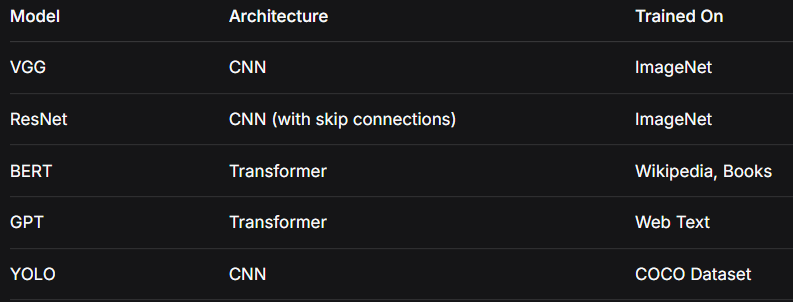
Popular Pre-trained Models
Applications of Transfer Learning
-
Medical Imaging: Using ImageNet models for disease detection
-
Sentiment Analysis: Using language models for product reviews
-
Object Detection: Using pre-trained models for custom objects
-
Speech Recognition: Using pre-trained audio models
7. Vision Transformers (ViT)
What Are Vision Transformers?
Vision Transformers apply the transformer architecture to computer vision tasks. Instead of processing images as grids of pixels, ViT processes images as sequences of patches .
"ViT transformer ko vision mein use karta hai."
How ViT Works
The image is divided into patches, and each patch is treated like a word in a sentence:
Image → Patch Embeddings → Transformer Encoder → Classification
-
Split image into patches (like 16×16 pixels)
-
Flatten each patch into a vector
-
Add positional embeddings
-
Process through transformer blocks
-
Classify using CLS token
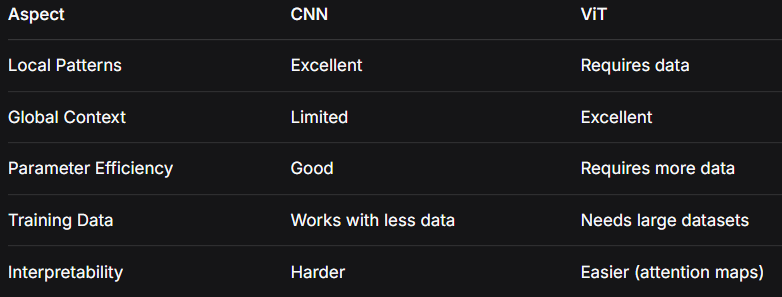
ViT vs CNN
Applications of ViT
-
Image Classification: Medical imaging, satellite imagery
-
Object Detection: Finding objects in images
-
Self-Supervised Learning: Learning from unlabeled images
-
Multimodal Tasks: Combining vision and language
8. Image Processing with Deep Learning
Deep learning has revolutionized image processing. Here are the key applications:
Image Classification
Identifying what is in an image. This is the most common application.
Example: Distinguishing cats from dogs, identifying plant species, detecting diseases.
Object Detection
Finding and localizing objects within an image.
Example: Self-driving cars detect pedestrians, medical imaging detects tumors.
Semantic Segmentation
Classifying every pixel in an image.
Example: Autonomous driving (road vs. sidewalk vs. cars), medical imaging (tissue segmentation).
Image Generation
Creating new images from scratch or transforming existing ones.
Example: DALL-E generating images from text descriptions, enhancing old photos.
9. Text Processing with Deep Learning
Deep learning has transformed how we process text data.
Natural Language Processing (NLP)
NLP involves understanding and generating human language.
Applications:
-
Machine Translation (Google Translate)
-
Sentiment Analysis (Product reviews)
-
Question Answering (Chatbots)
-
Text Summarization (News summaries)
Large Language Models (LLMs)
Models like GPT-4 and BERT have revolutionized text processing.
Key Features:
-
Understand context and nuance
-
Generate coherent text
-
Answer questions
-
Write code
10. Audio Processing with Deep Learning
Deep learning has enabled remarkable advances in audio processing.
Speech Recognition
Converting speech to text.
Example: Siri, Google Assistant, speech-to-text transcription.
Music Generation
Creating music using AI.
Example: Jukebox by OpenAI, AI-generated music.
Audio Classification
Identifying sounds in audio.
Example: Voice command recognition, detecting events from audio.
Model Examples
RNNs and LSTMs: Handle time series and sequential data in audio signals
Transformers: For end-to-end speech recognition
CNNs: For extracting features from spectrograms
11. Video Processing with Deep Learning
Video processing combines vision and temporal understanding.
Video Classification
Classifying the content of a video.
Example: Detecting activities in surveillance footage.
Action Recognition
Identifying actions being performed.
Example: Recognizing a person running, jumping, cooking.
Video Generation
Creating videos from scratch or transforming existing ones.
Example: AI-generated videos, video style transfer.
Model Examples
CNN + RNN: Process spatial and temporal features
3D CNNs: Process spatiotemporal features directly
Video Transformers: Use attention across video frames
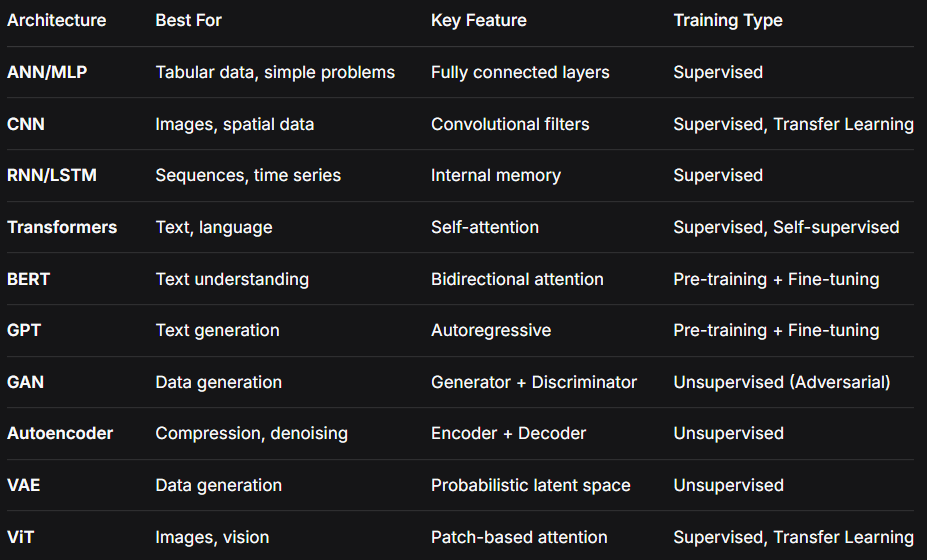
Complete Overview: Architecture Comparison
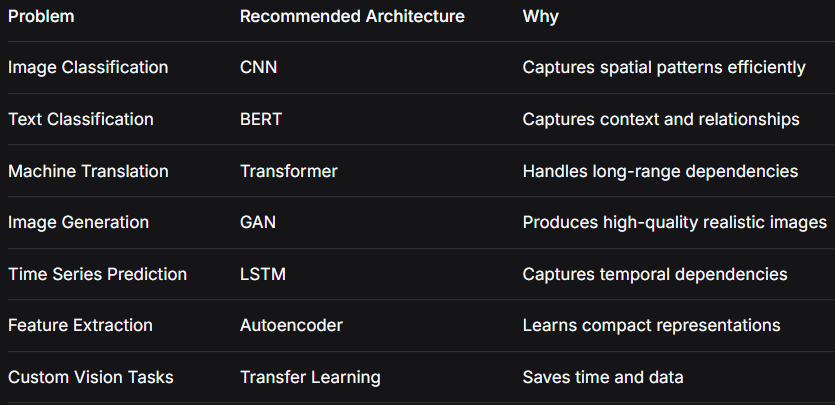
Choosing the Right Architecture
Here's a simple guide to help you choose the right architecture for your problem:
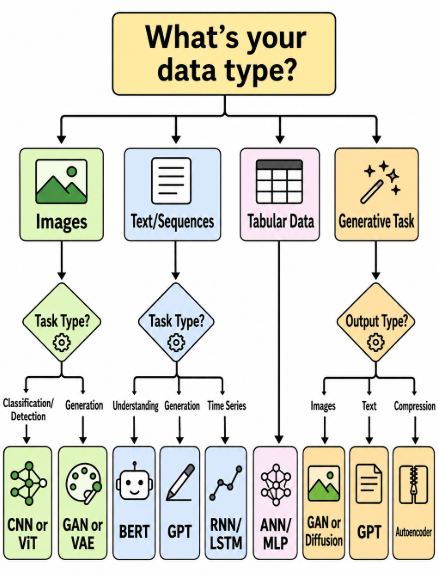
How to make quick Decisions?
Conclusion
Our ANN journey has been incredible. From the simple perceptron to the complex world of deep learning, we've covered a lot of ground. But as we've seen today, ANNs are just one chapter in a much larger story.
But from now each architecture has its strengths and weaknesses. Each is designed for specific types of problems. And together, they form the foundation of modern artificial intelligence.
"Yeh tha deep learning ka complete ecosystem."
But the world of AI doesn't stop here. We have optimization techniques, advanced architectures, and real-world applications to explore. There's always something new to learn in this rapidly evolving field.
The possibilities are endless. The tools are in your hands. Go build something amazing!