
The Birth of Intelligence: How Perceptrons Learned from the Human Brain
"Every great invention begins with a simple question. Artificial Intelligence also began with one."
Note: This is the first article in a beginner-friendly Deep Learning series. It explains the intuition behind perceptrons by connecting them with the human brain and gradually building toward Artificial Neural Networks.
Imagine This...
Imagine you are sitting in a classroom. Your teacher holds up a fruit and asks,
"Is this an apple?"
You do not immediately answer. Your brain silently checks several characteristics.
- Is it round?
- Is it red or green?
- Does it have a stem?
- Is its size similar to an apple?
- Does it look familiar?
Within a fraction of a second, your brain combines all these observations and confidently answers,
"Yes, it is an apple."
You never consciously perform these calculations, yet your brain does them continuously.
This simple ability to receive information, process it, and make a decision inspired one of the earliest models in Artificial Intelligence: the Perceptron.
The Inspiration: Human Neurons
Before scientists attempted to build intelligent machines, they first asked a fundamental question.
How does the human brain make decisions?
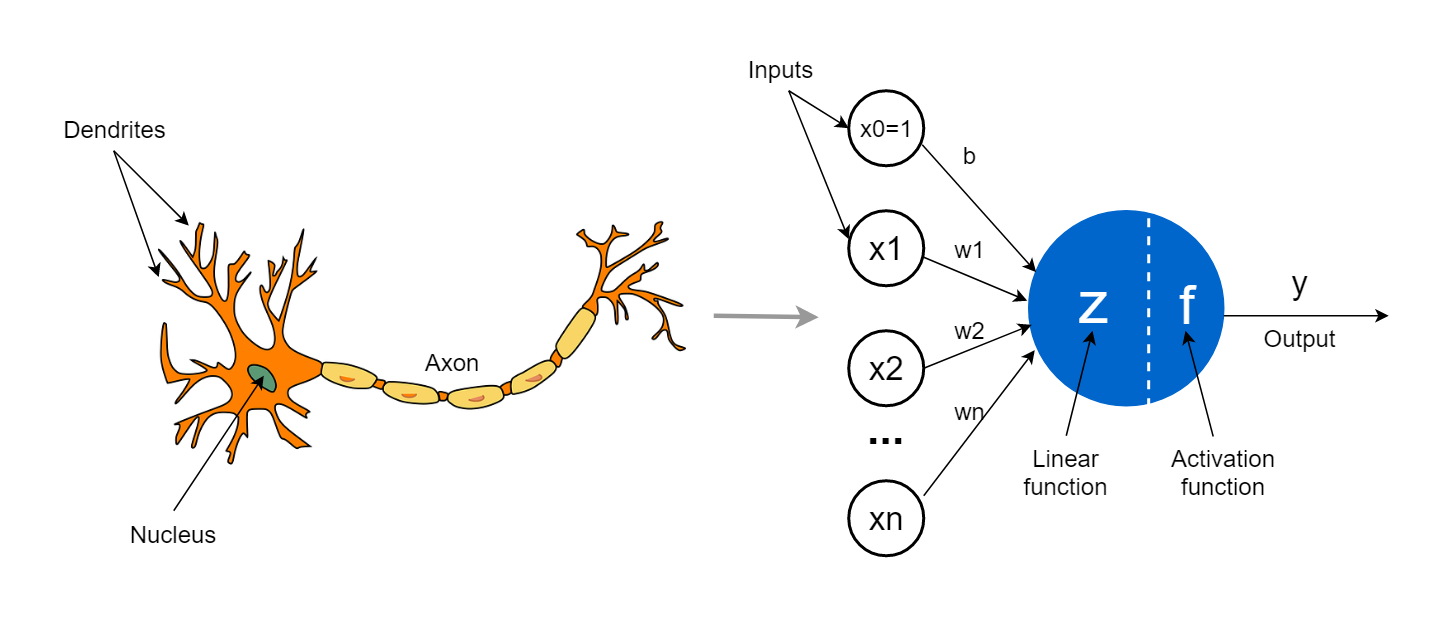
The human brain contains nearly 86 billion neurons. Every neuron is a tiny processing unit responsible for receiving information, processing it, and passing the result to other neurons.
A biological neuron performs three basic tasks.
- Receives signals through dendrites.
- Processes those signals inside the cell body.
- Sends an output through the axon.
Input Signals (Dendrites)
          │
          ▼
     Cell Body
          │
          ▼
 Output Signal (Axon)
One important observation fascinated researchers.
Not every signal has the same importance.
For example, if someone calls your name loudly in a crowded room, your brain immediately prioritizes that sound over the surrounding noise.
Importance matters.
This simple idea eventually became the concept of weights in Artificial Neural Networks.
The Birth of the Perceptron
In 1957, psychologist and computer scientist Frank Rosenblatt introduced the Perceptron.
His goal was straightforward but revolutionary.
Can a machine learn to make decisions by observing examples instead of following fixed instructions?
Until then, computers could only execute explicitly written programs.
Rosenblatt proposed a different idea.
Instead of hardcoding every rule, why not build a mathematical model that behaves like a simplified neuron?
This became the Perceptron, the first learning algorithm capable of classifying data.
What is a Perceptron?
A perceptron is the smallest computational unit of an Artificial Neural Network.
It accepts multiple inputs, assigns an importance to each input, combines them mathematically, and finally produces a decision.
x₁ ─┐
    │
x₂ ─┼────► [ Perceptron ] ───► Output
    │
x₃ ─┘
Although it is a mathematical model, every part of the perceptron is inspired by a biological neuron.
| Human Neuron | Artificial Perceptron |
|---|---|
| Dendrites | Inputs |
| Signal Strength | Weights |
| Cell Body | Weighted Sum |
| Axon | Output |
| Decision to Fire | Activation Function |
Bas itna sa mapping hi Artificial Neural Networks ki foundation ban gaya.
The Four Building Blocks
Inputs
Inputs represent the information received by the perceptron.
Example:
Hours Studied = 8
Attendance = 90
Assignments = 10
Mathematically,
x₁, x₂, x₃
Weights
Every feature contributes differently.
If you are predicting whether a student will pass, study hours might matter more than attendance.
Weights capture this importance.
Hours Studied → 0.8
Attendance → 0.4
Assignments → 0.6
Simply put,
Weight = Importance
Ye concept jitna simple lagta hai, utna hi powerful hai.
Bias
Bias allows the perceptron to shift its decision boundary.
Think of a cricket umpire standing slightly left or right before the ball is bowled. That initial position influences what the umpire sees.
Similarly, bias gives the perceptron flexibility while making decisions.
Activation Function
After computing the weighted sum, the perceptron decides whether it should activate.
For the original perceptron, the decision rule is simple.
If z > 0
    Output = 1
Else
    Output = 0
The Mathematics Behind the Decision
The perceptron computes
z = w₁x₁ + w₂x₂ + w₃x₃ + b
where
- x = Inputs
- w = Weights
- b = Bias
This value is called the weighted sum.
The activation function then converts this value into the final prediction.
Geometric Intuition
This is where the perceptron becomes beautiful.
Imagine plotting students based on two features.
- Hours Studied
- Attendance
      Pass

      ●   ●

----------------------------

○   ○   ○

      Fail
Can a straight line separate the two classes?
Yes.
That straight line is called the Decision Boundary.
Mathematically,
w·x + b = 0
Everything on one side belongs to one class.
Everything on the other side belongs to the second class.
In simple words,
A perceptron learns where to draw the best separating line.
Bas itni si geometry poore perceptron ko explain kar deti hai.
The Limitation
Now imagine this dataset.
●     ○

○     ●
No matter how you draw a straight line, you cannot separate these classes.
This is known as the XOR Problem.
The perceptron fails because it can only solve linearly separable problems.
Researchers solved this limitation by stacking multiple perceptrons together.
This gave birth to the Multi Layer Perceptron (MLP), which later evolved into modern Deep Learning architectures.
Why is the Perceptron Important?
Every modern neural network is built upon this simple idea.
Whether you study
- Artificial Neural Networks
- Convolutional Neural Networks
- Recurrent Neural Networks
- Transformers
- Large Language Models
the underlying intuition remains the same.
Receive information.
Assign importance.
Process it.
Make a decision.
Har advanced Deep Learning model ke andar ek perceptron ki philosophy zaroor hoti hai.
A Simple Example
Suppose we want to predict whether a student will pass.
Hours Studied = 8
Attendance = 90

Weights

Hours = 0.7
Attendance = 0.3

Bias = -5
The weighted sum becomes
z = (8 × 0.7) + (90 × 0.3) - 5
z = 27.6
Since
27.6 > 0
the perceptron predicts
Pass
Python Implementation
# Simple Perceptron Example

# Input Features
hours_studied = 8
attendance = 90

# Importance assigned to each feature
weight_hours = 0.7
weight_attendance = 0.3

# Bias value
bias = -5

# Calculate weighted sum
z = (hours_studied * weight_hours) + \
    (attendance * weight_attendance) + bias

# Step Activation Function
if z > 0:
    prediction = "Pass"
else:
    prediction = "Fail"

print("Weighted Sum:", z)
print("Prediction:", prediction)
Expected Output
Weighted Sum: 27.6
Prediction: Pass
Final Thoughts
The perceptron may appear to be a simple mathematical equation, but it changed the direction of Artificial Intelligence forever.
Inspired by the human neuron, it introduced the idea that machines can learn from data instead of relying only on manually written rules.
Today, every Deep Learning model traces its roots back to this foundational concept.
As you continue learning Artificial Neural Networks, remember that every complex architecture begins with one small neuron making one simple decision.
Sometimes, the biggest revolutions start with the simplest ideas.